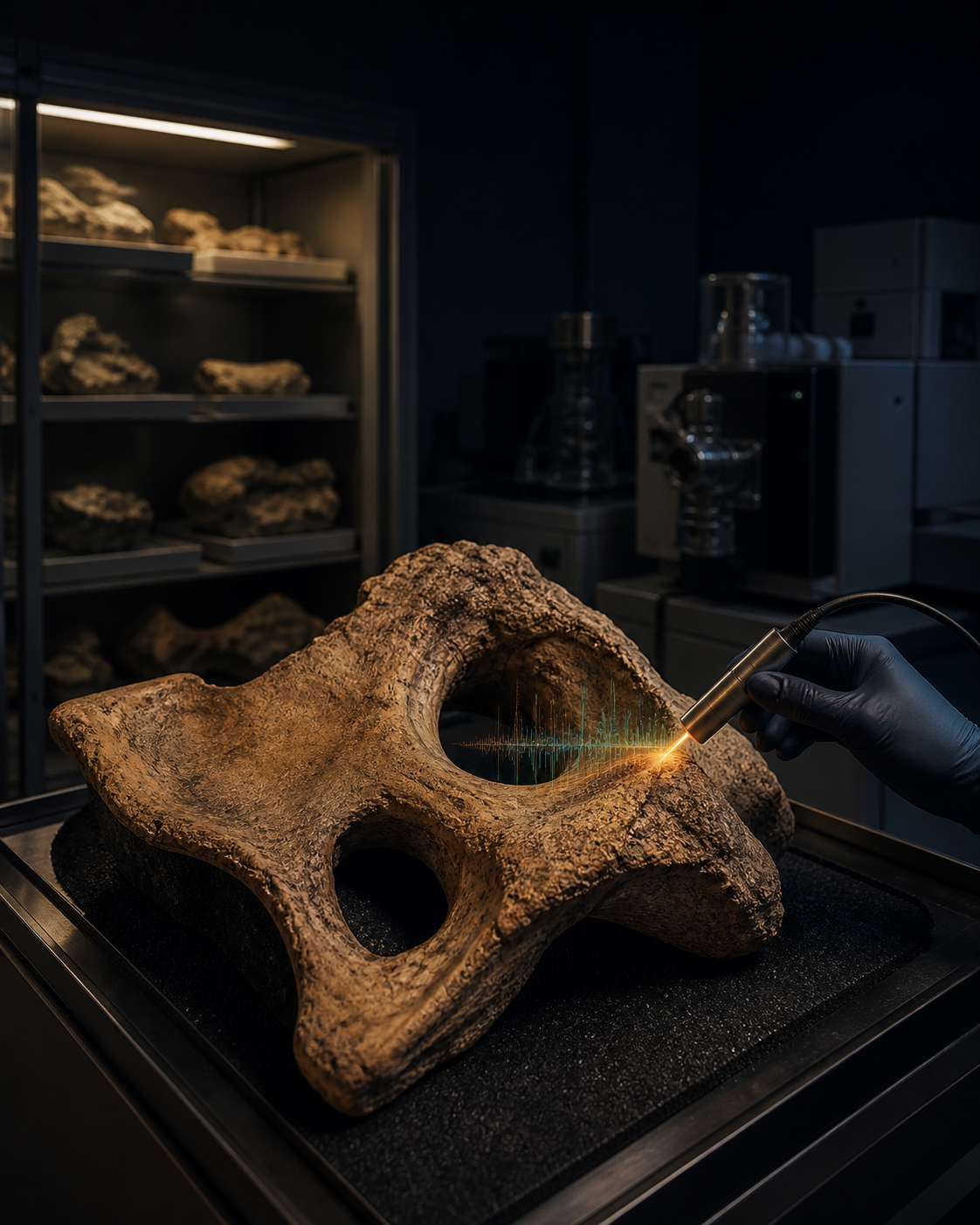
Traces of collagen reported in a 66-million-year-old dinosaur bone
Edmontosaurus
A large plant-eating dinosaur that lived near the end of the Cretaceous Period.
collagen
A protein that helps give bone its structure.
mass spectrometry
A method for identifying small chemical components in a sample.
What happened
Researchers led by the University of Liverpool reported evidence for traces of collagen in a fossil bone from Edmontosaurus, a plant-eating dinosaur that lived about 66 million years ago. The specimen was a 22-kilogram bone from the hip area, found in South Dakota, United States.
Collagen is a major structural protein in bone. The report challenges the simple idea that fossilization always removes every original biological material and leaves only mineralized rock.
How the team tested it
The team used several laboratory approaches on the same fossil. These included protein sequencing and forms of mass spectrometry, which can identify small chemical components. Researchers also reported hydroxyproline, an amino acid strongly linked with collagen in bone.
That combination matters because a single signal can be difficult to interpret. The researchers used several kinds of evidence to argue that the material was inside the fossil bone and was not simply modern contamination.
The debate behind the result
Reports of soft-tissue-like structures and proteins in dinosaur fossils have prompted debate for decades. Some researchers have argued that such findings could be contamination or material from modern microbes, rather than molecules from the dinosaur.
This study does not make that broader debate disappear. Its contribution is a detailed case for one Edmontosaurus fossil, using multiple methods. The underlying paper, “Evidence for Endogenous Collagen in Edmontosaurus Fossil Bone,” appeared in the journal Analytical Chemistry in 2025.
Why it could matter
A surviving protein fragment could offer a different kind of clue from a fossil's shape. The team says it could eventually help researchers investigate relationships among dinosaur species, as well as growth, age, body function, and disease.
It could also change which museum specimens deserve another look. Older microscope images of fossil bone may help identify samples that are worth testing with newer chemical tools.
What is established, and what is not
The reported evidence concerns one especially well-preserved Edmontosaurus bone. It includes chemical signs that fit degraded collagen, not a complete, fresh protein from a dinosaur.
The report does not show that all dinosaur fossils preserve original proteins. It also does not explain exactly why the possible fragments lasted so long, or settle every concern about contamination. Those questions need studies of more specimens and independent tests.
What to watch next
The key next step is replication. Scientists will need to test other fossils, compare results across laboratories, and show how possible contamination was ruled out. Only then can researchers tell how often ancient protein fragments survive and how much biological information they can reliably reveal.
A dinosaur bone may still hold tiny traces of its old protein
📰 Full story: Traces of collagen reported in a 66-million-year-old dinosaur bone
Scientists found signs of collagen in a dinosaur bone about 66 million years old. They now need more tests to learn what those signs mean.
Edmontosaurus
A large dinosaur that ate plants.
collagen
A protein that helps make bones strong.
mass spectrometry
A tool for finding tiny chemical pieces.
💡 The gist
- A dinosaur fossil showed signs of collagen.
- Collagen is a protein that helps make bones strong.
- The finding needs checks from more fossils and laboratories.
The fossil came from Edmontosaurus. It was a large dinosaur that ate plants. It lived about 66 million years ago.
Many people think a fossil is only a stone copy. Over a very long time, minerals can fill or replace bone. Scientists once expected all of the animal's original materials to disappear.
A research team studied a bone from the dinosaur's hip. They found chemical clues that fit broken-down collagen. Collagen is one of the main proteins in bone.
The team used more than one test. One was mass spectrometry. This method can help identify very small chemical pieces. The researchers also reported hydroxyproline. That is an amino acid often connected to collagen in bone.
Using several tests is important. A fossil can pick up modern dirt or microbes. If a team sees only one clue, it can be hard to know where it came from. The researchers say their different results support the idea that the clues came from inside the ancient bone.
Still, this is not the final answer. Scientists have debated claims of ancient proteins for years. Some have said similar materials might be modern contamination. This report studies one well-preserved fossil. It cannot prove that every dinosaur fossil keeps old proteins.
If the result holds up, it could be useful. Bone shapes tell scientists a lot. Protein fragments might add clues about how dinosaur groups were related. They might also help with questions about growth or body function.
The next tests matter most. Other teams need to study other fossils. They also need to show carefully how they ruled out modern material. That work will tell us whether fossil bones can sometimes keep molecular messages from deep time.
A tiny dinosaur-bone clue
📰 Full story: Traces of collagen reported in a 66-million-year-old dinosaur bone
A very old dinosaur bone may have kept a tiny body piece.
Edmontosaurus
A big dinosaur from long ago.
collagen
A body material that helps bones stay strong.
Edmontosaurus was a dinosaur.
It lived a very long time ago.
Its bone is about 66 million years old.
Scientists looked inside the bone.
They found a clue for collagen.
Collagen helps make bones strong.
People thought old bones became only stone.
Maybe tiny body pieces can stay inside.
But dirt can get into old bones too.
So scientists must check again.
They will look at more dinosaur bones.
Then we may learn more about dinosaurs.